
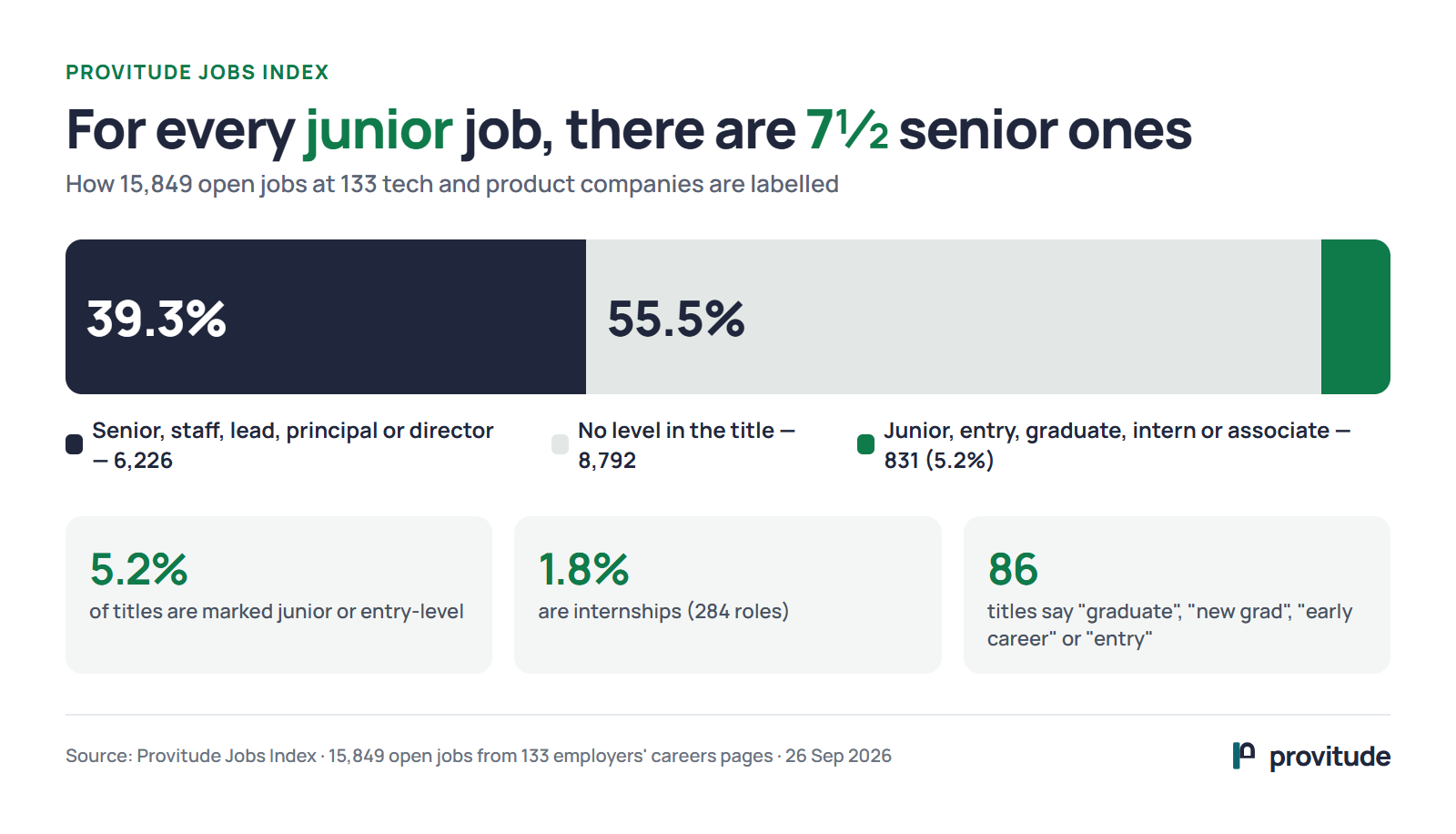
Only 4.3% of open jobs at tech and product companies are labelled junior, entry-level, graduate, intern or associate. Across 15,852 live job posts from 133 employers' own careers pages, we found 682 junior-labelled roles against 6,199 senior ones — roughly 9 senior jobs for every junior job. In engineering the ratio is 27 to 1.
If you're trying to get your first tech job and it feels like every listing wants "3–5 years of experience", you're not imagining it. Here is what the data says, where the openings actually are, and what to do about it.
- 15,852 open jobs analysed from 133 employers' careers pages (25 September 2026)
- 4.3% are labelled junior, entry-level, graduate, intern or associate (682 jobs)
- 39.1% are labelled senior, staff, lead, principal or director (6,199 jobs)
- 2.5% are internships (399 roles); only 88 titles say "graduate", "new grad", "early career" or "entry"
- Engineering: 2.0% junior vs 53% senior — 27 senior roles for every junior one
What we found
We sorted every job title into three groups using the words in the title itself:
| Group | Title contains | Jobs | Share |
|---|---|---|---|
| Senior | senior, sr., staff, principal, lead, head, director, VP | 6,199 | 39.1% |
| No level | no level word at all ("Account Executive", "Data Analyst") | 8,971 | 56.6% |
| Junior | junior, jr., entry, graduate, intern, associate, apprentice | 682 | 4.3% |
Two things stand out. First, the senior group alone is nine times the size of the junior group. Second, more than half of all roles don't say a level at all — and many of those still ask for several years of experience in the description. So 4.3% is the share of jobs that openly welcome early-career people; it is not the only door, but it is a very small one.
The gap is widest in engineering and design
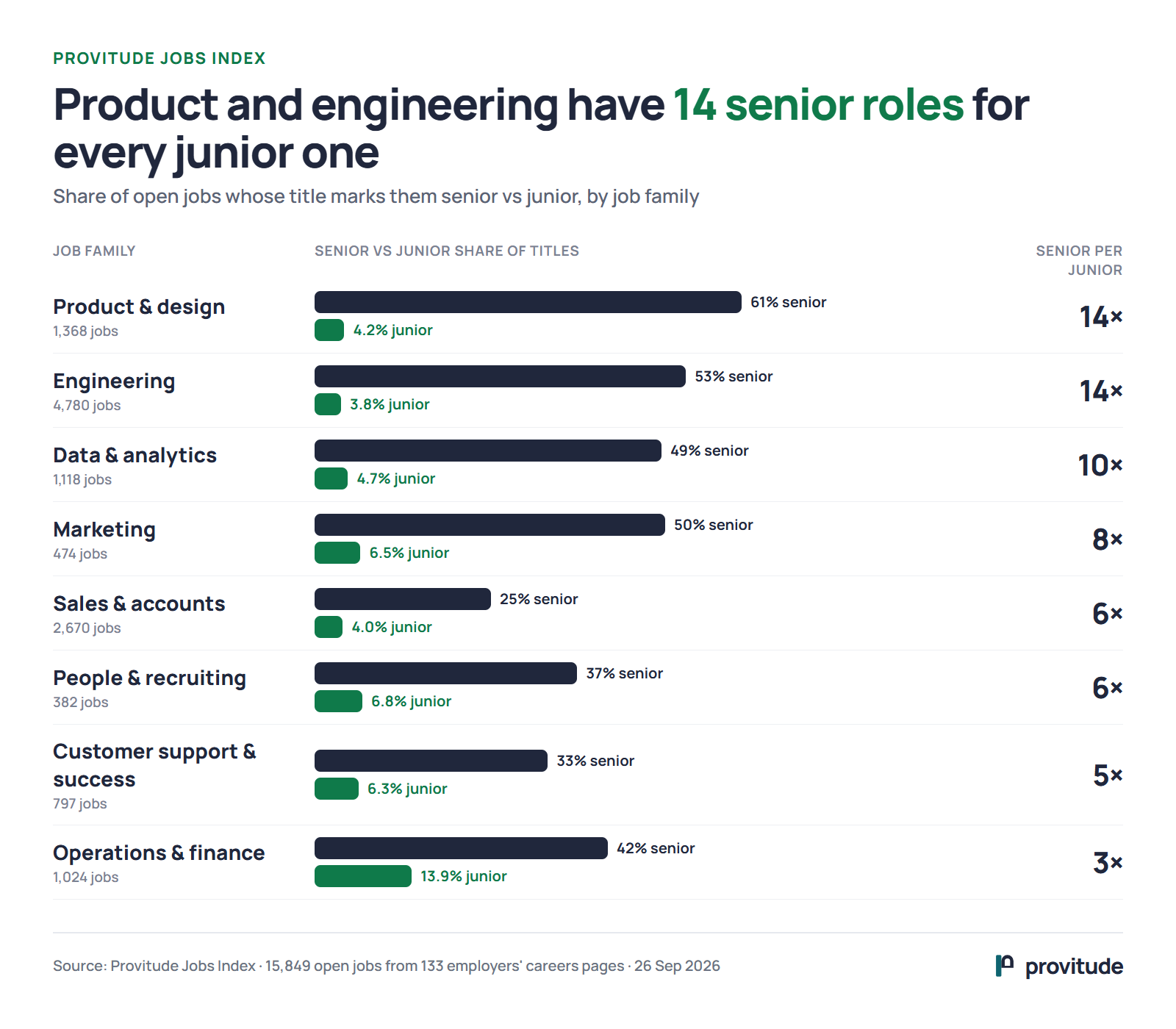
| Job family | Open jobs | Junior | Senior | Senior per junior |
|---|---|---|---|---|
| Engineering | 4,785 | 2.0% | 52.9% | 27× |
| Product & design | 1,254 | 2.8% | 62.2% | 22× |
| Data & analytics | 1,120 | 4.6% | 49.3% | 11× |
| Marketing | 475 | 5.3% | 50.1% | 10× |
| Sales & accounts | 2,667 | 3.8% | 24.9% | 7× |
| Customer support & success | 797 | 5.8% | 33.1% | 6× |
| People & recruiting | 295 | 7.1% | 35.3% | 5× |
| Operations & finance | 956 | 14.2% | 41.6% | 3× |
If you're early in your career and flexible about where you start, the data points to operations and finance (one junior role in seven), people and recruiting, and customer support and success as the most open doors. Engineering and product design are the hardest to enter directly, which is why support, QA, operations and internships are such common first steps into those fields.
Why companies post so few junior roles
Companies rarely explain their hiring mix, but three explanations fit the pattern:
- Small teams can't afford training time. A company hiring one engineer this quarter wants someone who needs no ramp-up.
- CVs are a poor signal for beginners. With no track record to read, a CV from a new graduate looks like every other CV. Hiring someone "senior" feels safer than guessing.
- Levels are inflated. Many "senior" roles are really mid-level jobs with a better title to attract applicants.
The second point is the one you can actually do something about.
What to do if you're looking for your first role
You can't change the ratio, but you can change what an employer sees when your application lands.
- Apply to the roles with no level in the title. Over half of all jobs don't say "senior". Read the description: if it asks for skills you can demonstrate rather than a fixed number of years, apply.
- Replace "experience" with evidence. A short work sample — a SQL query that answers a real business question, a support reply to an angry customer, a one-page product critique — tells a hiring manager more than a line on a CV. Our skill packs are a free way to find your gaps first.
- Target the open doors, then move. Support, QA, operations and implementation roles open to juniors more often and are well-worn routes into engineering, data and product.
- Practise the interview before you get it. When junior roles are this scarce, the candidates who get offers are the ones who answer clearly and specifically. Practise real questions for your target role — privately, as many times as you like.
Methodology and limitations
- Data: 15,852 open job posts collected on 25 September 2026 from the public careers feeds (Greenhouse, Lever, Ashby and SmartRecruiters) of 133 employers, mostly technology and product companies. At most 300 jobs are collected per employer, so the largest employers are capped.
- Classification: based on job titles only, using the keyword lists in the first table. A title such as "Associate Director" counts as senior because senior words are checked first. Descriptions were not analysed, so jobs with no level in the title may still require years of experience.
- Families: a job can match more than one family (for example "Product Data Analyst"), so family totals add up to more than 15,852.
- Not a sample of the whole labour market: these are tech and product employers with public careers feeds. Retail, healthcare, government and small businesses are not included.
We will refresh these numbers every quarter at this address. Journalists and researchers are welcome to use the charts and figures with a link to this page as the source. Questions about the data: hello@provitude.com.