
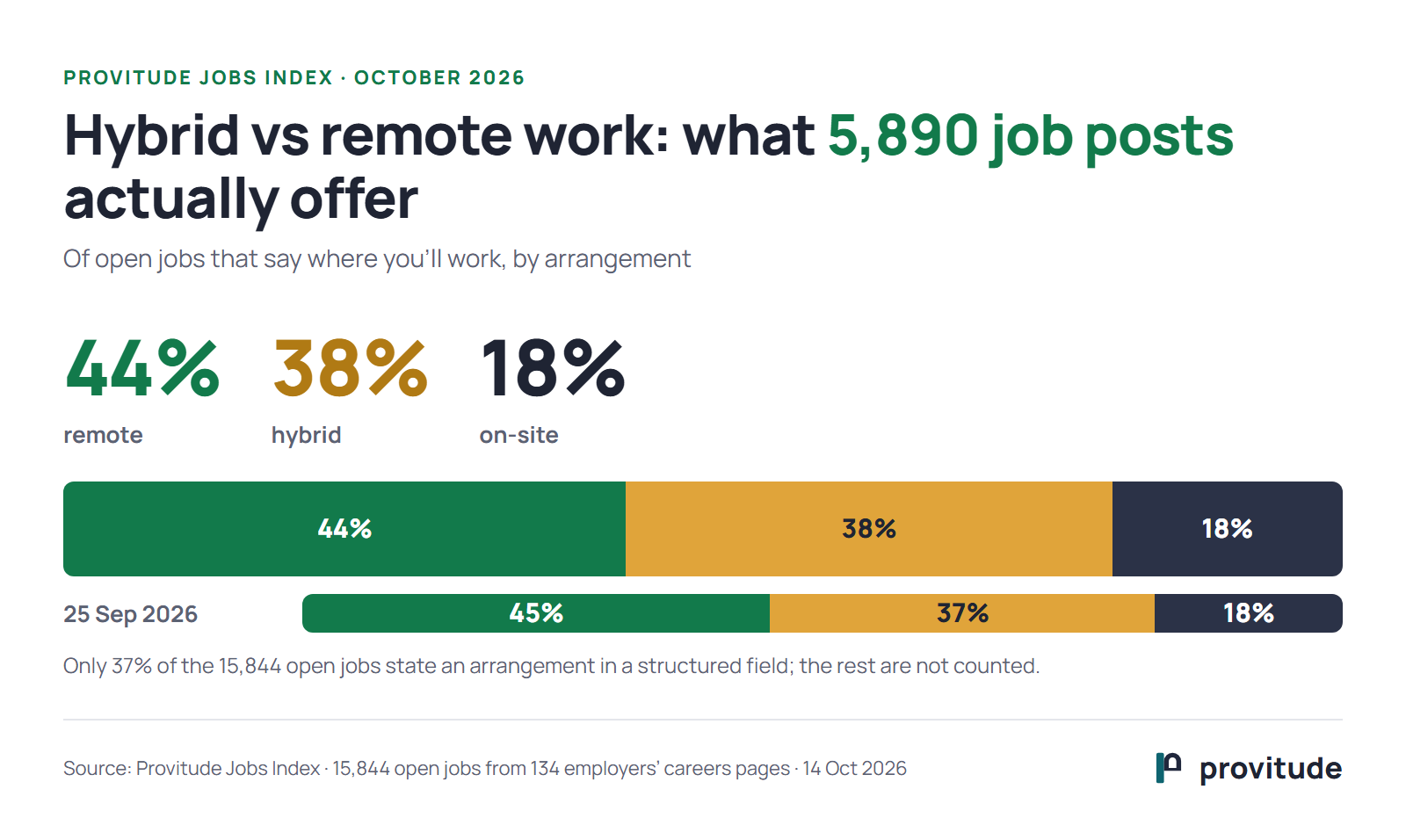

Hybrid vs remote work, by the numbers: of 15,844 open jobs Provitude tracked on 14 October 2026, 5,890 say how you'd work — and 44% of those are fully remote, 38% hybrid and 18% on-site. Remote work means you can work from anywhere (often within a country or time zone); hybrid means a set number of office days each week; on-site means the office every day. The overall split barely moved in three weeks. The bigger story is underneath it: as soon as a job names a city, hybrid takes over — 61% in San Francisco, 68% in New York and 58% in London.
These numbers come from the Provitude Jobs Index: open roles imported from the public careers pages of 134 employers, most of them tech companies. Methodology and limitations are at the end.
- 15,844 open jobs from 134 employers' careers pages (14 October 2026)
- 5,890 (37%) state a work arrangement: 44% remote, 38% hybrid, 18% on-site
- Three weeks earlier (25 September): 45% remote, 37% hybrid, 18% on-site — essentially unchanged
- Jobs located in a named city are mostly hybrid: San Francisco 61%, New York 68%, London 58%
- Seattle and Bengaluru lean on-site (55% and 61%)
- Customer-facing roles are the most remote: customer success 62%, account executives 58%, engineers 46%
Hybrid vs remote work: what the labels actually mean
| Arrangement | What it usually means | Read the small print for… |
|---|---|---|
| Remote | You can work from anywhere — often with limits. | "Remote (US only)", "remote within UK time zones", occasional travel for team meetings. |
| Hybrid | Some days in the office, some at home. | How many days, which days, and whether that's "expected" or "required". |
| On-site | In the office (or on the shop floor) every working day. | Start times, shift patterns, and whether any flexibility exists after probation. |
Two phrases worth knowing: remote-first companies design work around remote staff (meetings, documents, promotions); remote-friendly ones allow remote work but run mostly from an office. Both can say "remote" in the job post.
Finding 1: remote is the biggest group, but hybrid is close behind
Of the 5,890 jobs that state an arrangement, 2,603 are remote (44%), 2,251 hybrid (38%) and 1,036 on-site (18%). Three weeks earlier, on 25 September, the split was 45%, 37% and 18% across 5,868 jobs — the same picture within a percentage point.
So the honest answer to "is hybrid or remote more common?" in these job posts is: remote, narrowly — and on-site is the clear minority. Three weeks is far too short to call a trend; we'll re-run this every quarter on the same page.
Finding 2: name a city, and hybrid takes over
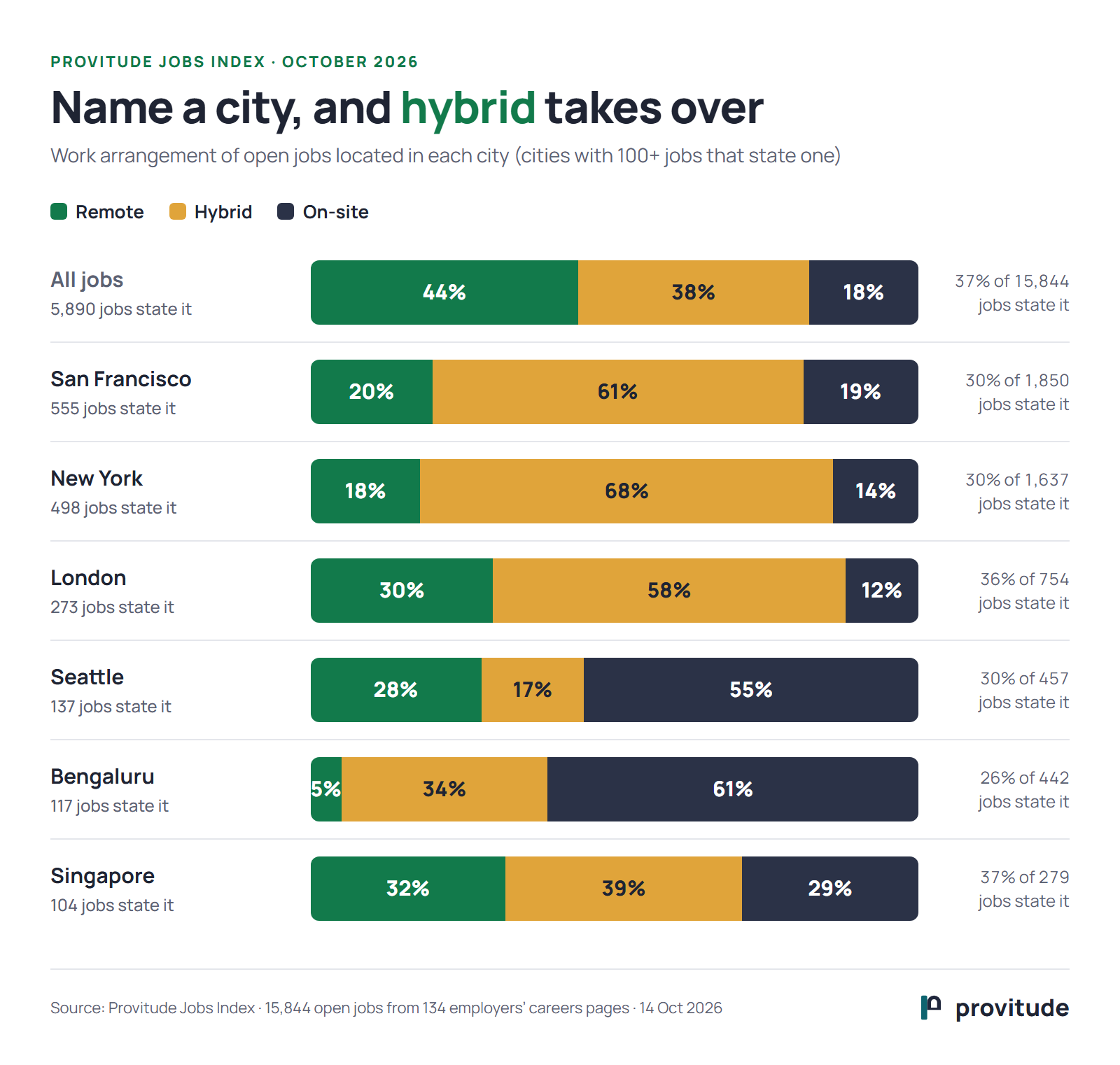
Fully remote jobs mostly don't name a city at all — they say "Remote", "United States" or a region. Jobs that do name a city tell a different story:
- New York (68% hybrid), San Francisco (61%) and London (58%) are hybrid cities. If you're applying for a job based in one of them, expect office days — and ask how many.
- Seattle (55% on-site) and Bengaluru (61% on-site) lean towards the office every day.
- Singapore is the most evenly split: 32% remote, 39% hybrid, 29% on-site.
We only show cities with at least 100 jobs that state an arrangement. Berlin, Paris and Amsterdam each had more than 150 open jobs, but too few stated an arrangement to say anything reliable.
Finding 3: customer-facing roles are the most remote
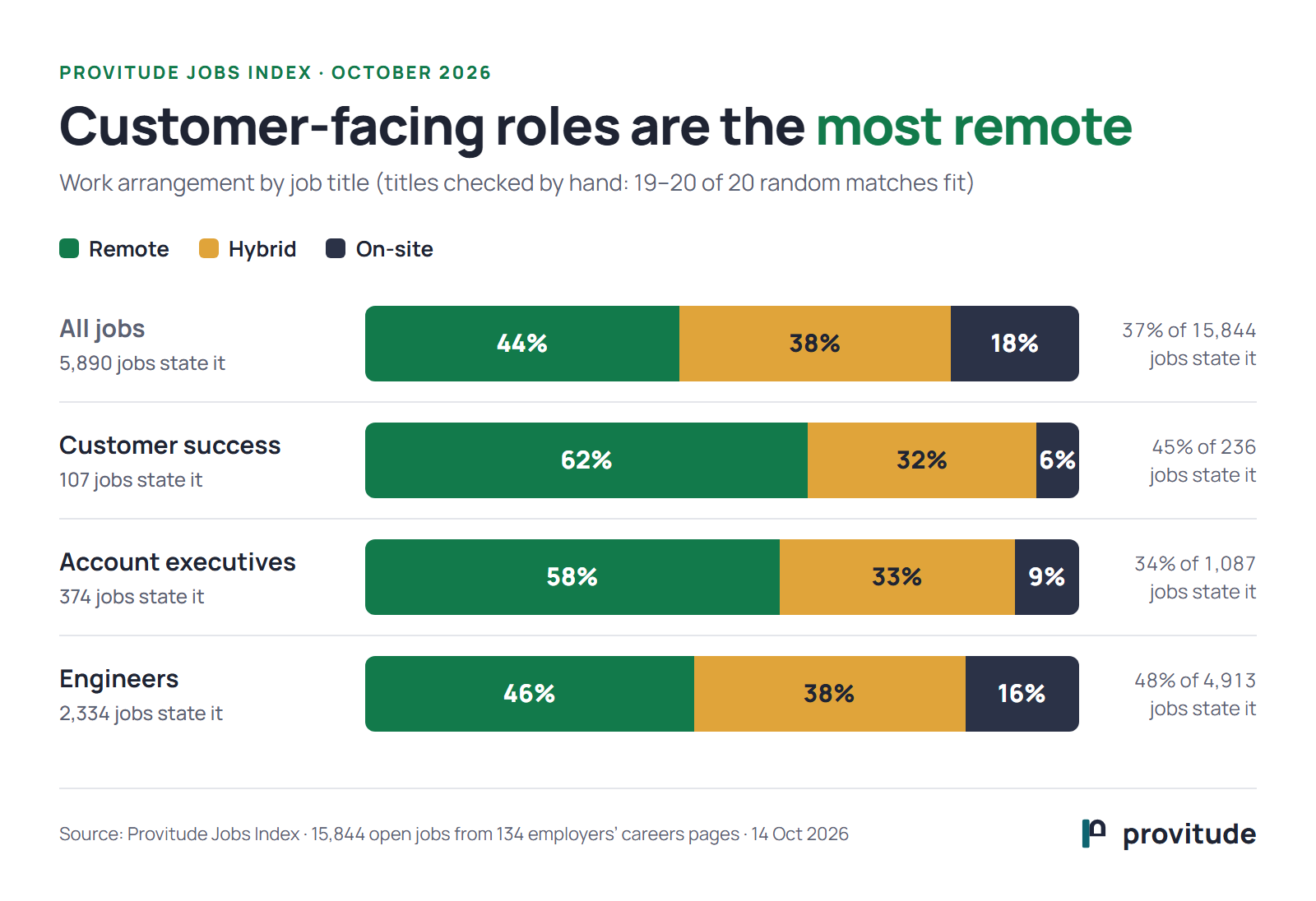
- Customer success: 62% remote (107 jobs state an arrangement)
- Account executives: 58% remote (374 jobs)
- Engineers: 46% remote (2,334 jobs) — close to the overall average
Roles built around calls and video meetings with customers are the easiest to do from anywhere, and these job posts reflect that. If fully remote work is your priority, customer-facing roles are where the odds are best in this data.
Finding 4: most job posts don't say
Only 37% of the 15,844 open jobs state an arrangement in a structured field. The rest may mention it somewhere in the description — or not at all. For candidates, that means one question in the first conversation saves everyone time: "Is this role remote, hybrid or office-based, and how many days?"
What this means if you're job hunting
- Filter first. On Provitude you can browse remote jobs or hybrid jobs directly.
- Read the small print on "remote". Country restrictions and time-zone requirements are the most common catches.
- Ask about office days early. If a job names a city, it's more likely than not to be hybrid. Ask in your first call — it's one of the best questions to ask at the end of an interview too.
- Remote days are negotiable. If the salary is fixed, an extra home-working day is often easier for an employer to give. Here's how to negotiate salary — and the rest of the package.
- Make your remote skills visible. Remote hiring depends heavily on written work and clear evidence. Proving a skill with a short assessment gives employers something concrete to judge.
What this means if you're hiring
If 63% of job posts don't clearly state the arrangement, simply saying it puts you ahead. Put "Remote (UK time zones)", "Hybrid — 2 days a week in London" or "On-site" in the title or first line, and in the right field of your careers page. Here's how to write a job description that answers candidates' first questions before they have to ask.
Methodology and limitations
- Source: the Provitude Jobs Index — open jobs imported from the public careers pages of 134 employers, counted through Provitude's public job search on 14 October 2026 (07:56 UTC). The same listings power our jobs board.
- Work arrangement comes from each job's structured remote/hybrid/on-site field as published by the employer's careers system. Jobs without that field (63%) are excluded from all percentages; some of them state an arrangement in the description text, which we don't count.
- Cities: a job counts for a city when its location text contains the city's name, so a post listing several cities counts in each. "Bengaluru" and "Bangalore" are combined. Only cities with at least 100 jobs stating an arrangement are shown.
- Roles: jobs whose title (or company or department) contains the phrase. We checked 20 random matching jobs per phrase by hand and kept only phrases where at least 19 of 20 were genuinely that role (engineer 19/20, account executive 20/20, customer success 20/20). We dropped "sales" (11/20 matched — it caught consultant titles), "product manager" (15/20) and "marketing" (17/20).
- Rounding: percentages are rounded so each bar adds up to 100.
- Who this represents: mostly technology companies with public careers pages — not the whole job market. Treat these as a view of what these employers are advertising, not of all jobs or all workers.
- The September comparison uses our 25 September 2026 snapshot (5,868 jobs stating an arrangement).
- The raw counts are available on request. You're welcome to use the charts with a link to this page as the source.
Previous Jobs Index report: the entry-level gap — only 5% of open tech jobs are junior.
Frequently asked questions
Is hybrid or remote work more common?
In the job posts we track, remote is slightly more common: 44% of jobs that state an arrangement are remote and 38% are hybrid. But jobs that name a specific city are mostly hybrid.
Which jobs are most often remote?
Customer-facing roles: 62% of customer success jobs and 58% of account executive jobs that state an arrangement are remote, compared with 44% across all jobs.
Is remote work declining?
Not in this data over the last three weeks — the split stayed at about 44–45% remote. We'll update this page quarterly to show longer-term changes.
What's the difference between hybrid and remote work?
Remote work means you're not expected in an office (though there may be location or time-zone limits). Hybrid means a fixed or expected number of office days each week, with the rest at home.