
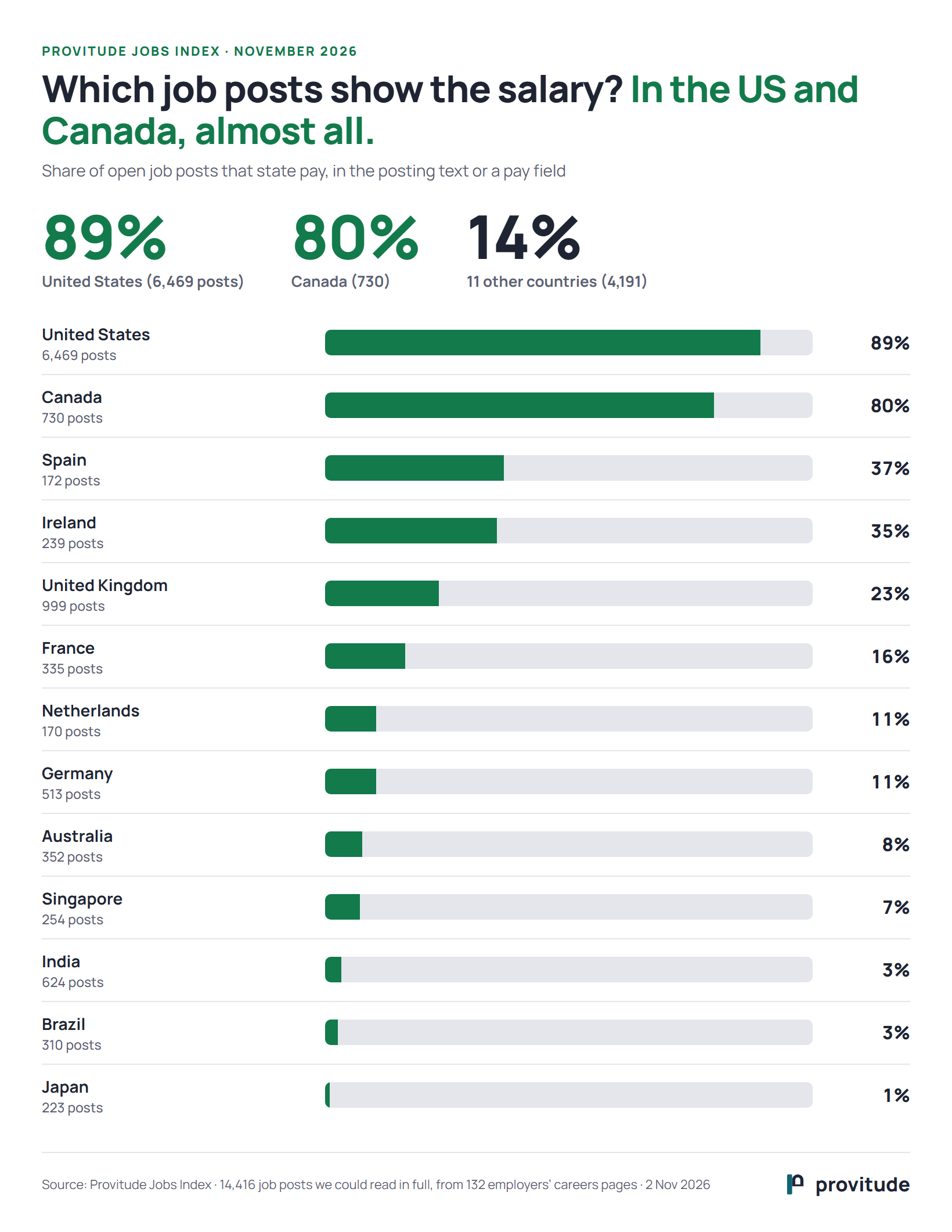

Salary transparency depends almost entirely on where a job is. Of 14,416 open job posts we read in full on 2 November 2026, 89% of those located in the US stated the pay, and 80% in Canada. Across the 11 other countries with enough posts to measure, it was 14%. The same employers that publish a salary range for a New York job usually leave it out of the London, Berlin or Bengaluru version of the same role.
The posts come from the Provitude Jobs Index: open roles on the public careers pages of 132 employers, most of them technology companies. We read each posting's text, not just its data fields, because that turns out to matter a lot. Methodology and limitations are at the end.
- 14,416 open job posts read in full, from 132 employers' careers pages (2 November 2026)
- 89% of US job posts state pay (5,775 of 6,469). Canada: 80%
- 14% across 11 other countries combined. UK 23%, Germany 11%, India 3%, Japan 1%
- US states with pay-range laws: 92%. Other states: 77%
- Only 17% of US posts put pay in a separate data field; the rest write it into the description
- The typical US range is wide: the top is 35% above the bottom (median)
What salary transparency means
Salary transparency (or pay transparency) means employers share pay information openly. In job ads, that usually means stating a salary range: "$120,000 to $150,000 a year" or "£40,000 to £45,000". It can also mean telling staff how pay is set, or publishing pay gaps. This report looks only at the first: does the job post tell you what the job pays?
Finding 1: it's a North American habit
| Where the job is | Job posts | State pay |
|---|---|---|
| United States | 6,469 | 89% |
| Canada | 730 | 80% |
| Spain | 172 | 37% |
| Ireland | 239 | 35% |
| United Kingdom | 999 | 23% |
| France | 335 | 16% |
| Netherlands | 170 | 11% |
| Germany | 513 | 11% |
| Australia | 352 | 8% |
| Singapore | 254 | 7% |
| India | 624 | 3% |
| Brazil | 310 | 3% |
| Japan | 223 | 1% |
The gap between North America and everywhere else is huge, and it isn't because the employers are different. Many of the 132 employers in the index hire in several countries. Their US posts carry a range; their posts for the same kind of job elsewhere often don't.
The obvious explanation is the law. In the US, a growing list of states and cities requires a pay range in job ads. In Canada, British Columbia has required expected pay or a pay range in public job postings since November 2023, and Ontario's requirement for publicly advertised jobs took effect in January 2026. Most of the other countries here have no such rule for job ads, so most employers don't volunteer it.
Finding 2: laws help, but most US employers post pay everywhere
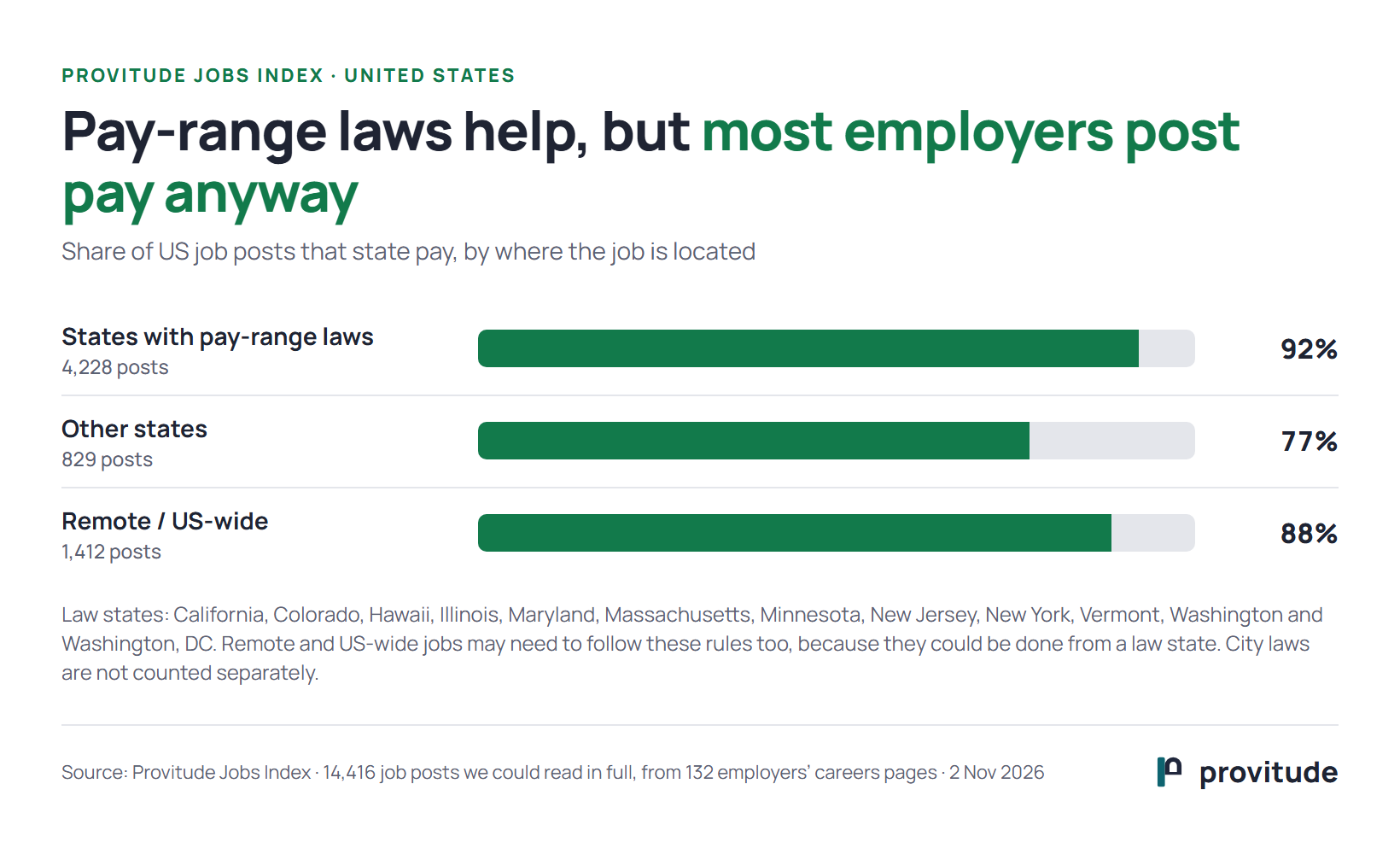
- Jobs located in states with pay-range laws (California, Colorado, Hawaii, Illinois, Maryland, Massachusetts, Minnesota, New Jersey, New York, Vermont, Washington and Washington, DC): 92% state pay (3,891 of 4,228).
- Jobs in other states: 77% (638 of 829). In Texas, which has no such law, it was 86% of 209 posts.
- Remote or US-wide jobs: 88% (1,246 of 1,412). These may have to follow the rules anyway, because the job could be done from a law state.
So the laws make a difference, but the bigger story is that once a US employer starts publishing ranges for some jobs, it tends to publish them for nearly all of them. Of the 61 employers with at least 20 US posts in our data, 46 stated pay in 90% or more of those posts. Only 7 stated it in fewer than half.
Finding 3: most pay information is hidden in the text
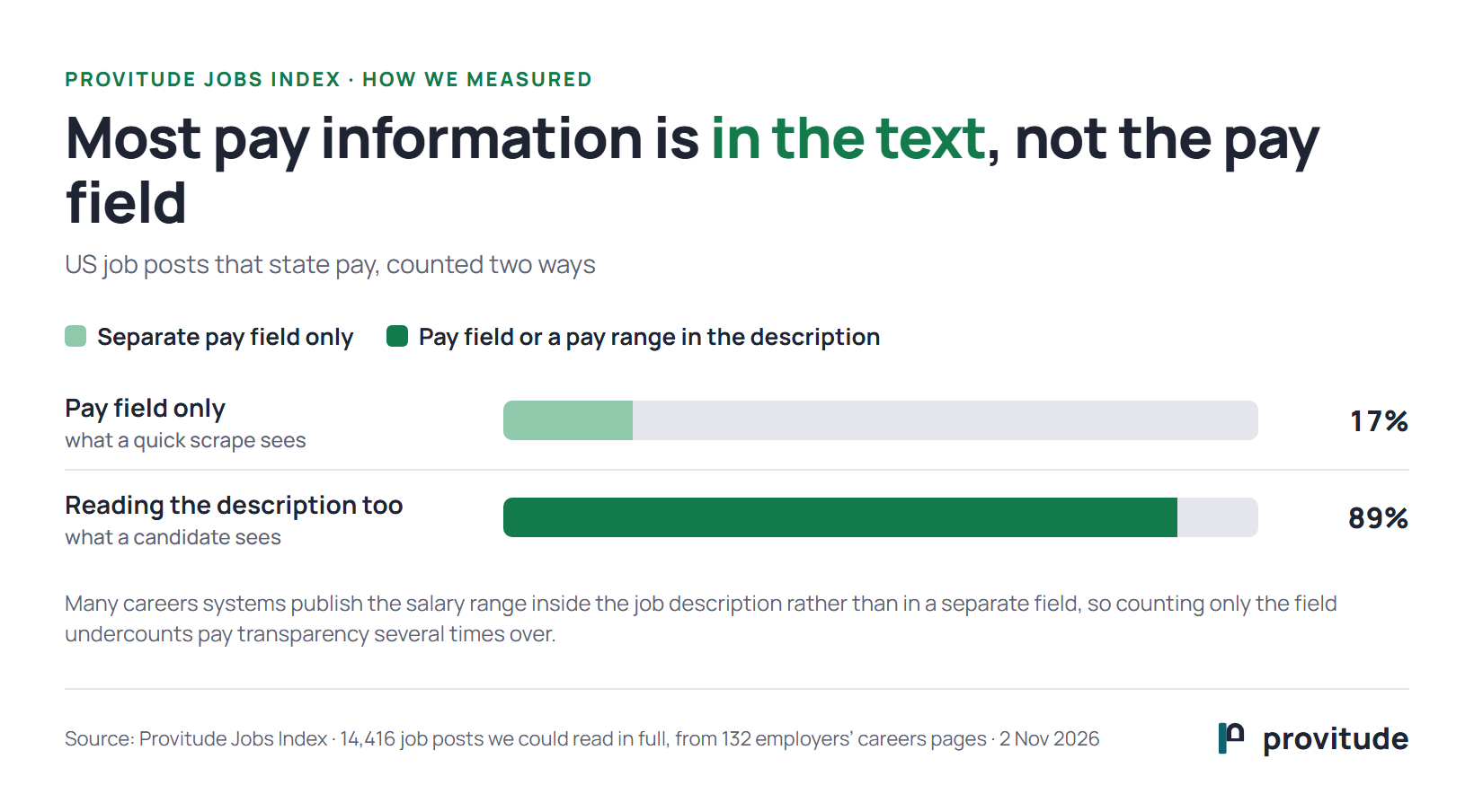
This is the finding that surprised us. Careers systems can publish pay in a separate, structured field that job boards and search engines can read easily. Only 17% of US posts did. Everyone else wrote the range into the job description, often near the bottom, under a heading like "Pay range" or "Compensation".
That matters if you've ever seen a claim like "only a small share of job ads show pay". If you count the data field alone, you'd conclude US employers are secretive. Read the posts the way a candidate does, and nine in ten tell you.
Finding 4: the ranges are wide
A range is only useful if it narrows things down. For US posts with an annual range, the top of the range was typically 35% higher than the bottom (median). A quarter of ranges had a top at least 50% above the bottom, and 3% had a top at least double the bottom. Some employers also list several ranges for different city "zones" or levels.
So a published range tells you whether a job is in your league, but not exactly what you'd be offered. Where you land usually depends on level, location and experience.
Finding 5: it doesn't depend much on the job
In the US, the share stating pay was between 88% and 92% for every job family we checked: engineering, data, product and design, sales, customer support, marketing, people and recruiting, and operations and finance. Senior roles (92%) and junior roles (90%) were much the same. Once an employer publishes pay, it publishes it for everyone.
What this means if you're job hunting
- In the US and Canada, expect a range, and ask if there isn't one. It's now normal; you won't seem pushy.
- Scroll down. The range is usually in the description, not at the top.
- Use ranges as research. Note the ranges for five or six similar jobs before you name a number. Our guides to negotiating salary and asking for a raise show how.
- Outside North America, ask early. If the ad says nothing, ask in the first conversation: "What's the budgeted range for this role?" In the EU, the Pay Transparency Directive (2023/970) gives job applicants the right to information about the starting pay or its range before the interview, though countries have been bringing it into national law at different speeds.
- Don't anchor on the top of a wide range. Where you land depends on level, location and experience, so prepare a reason for the number you ask for.
What this means if you're hiring
If you hire outside the US and Canada, publishing a range is still unusual, which means doing it helps you stand out. If you hire in the US, you're probably already doing it, but consider putting the range in your careers system's pay field too, so job boards can show it. And keep ranges honest: a range so wide it covers two levels doesn't help anyone. Our guide to writing a job description covers what else candidates look for.
Methodology and limitations
- Source: the Provitude Jobs Index, open jobs on the public careers pages (Greenhouse, Lever, Ashby and SmartRecruiters) of 132 employers, mostly technology companies, collected on 2 November 2026. At most 300 jobs per employer are included, as on our jobs board; 26 large employers hit that cap. Two employers whose jobs are currently hidden on Provitude were left out.
- What we read: 15,794 open jobs in total. For 14,416 of them we read the full posting: every Greenhouse, Lever and Ashby job, and up to 120 jobs per employer on SmartRecruiters, which needs one request per job. Percentages use those 14,416.
- "States pay" means the post includes a pay figure: a range or a single amount, annual or hourly, base pay or on-target earnings, in a separate pay field or in the description. We detect pay amounts next to a currency symbol or code, and exclude amounts that are clearly about funding, revenue, valuations, stipends or benefit budgets.
- Checks: we read 20 random posts counted as stating pay; all 20 were genuine pay information. We then looked at every US post counted as not stating pay that contained any currency amount (101 of 694). Almost all were funding or revenue figures; we found 4 likely pay ranges we had missed, which doesn't change the US figure at the reported precision.
- Location: taken from each job's location text. 1,497 readable posts had a location we couldn't assign to a country (for example "Remote" or "Europe") and 187 listed several countries; both are left out of the country rows. A job listing several US states counts as a law state only if all of them are. City-level laws (such as New York City's) are not modelled separately.
- Law states are those with a state law requiring pay ranges in job ads in force by November 2026, to the best of our knowledge.
- Who this represents: mostly technology employers large enough to run public careers pages. Small businesses, retail, healthcare and government jobs aren't included. Country figures reflect these employers' posts in each country, not that country's whole job market; the smaller country samples (under 300 posts) are less certain.
- Range width uses the first US-dollar annual range in each post (5,483 posts).
- You're welcome to use the charts and figures with a link to this page as the source. Earlier Jobs Index reports: hybrid vs remote work and the entry-level gap.
Frequently asked questions
What is salary transparency?
Salary transparency means employers share pay information openly, most visibly by putting a salary range in job ads. Some laws also give employees the right to ask how their pay compares with colleagues doing similar work.
What share of job posts include the salary?
In our November 2026 data from 132 employers, 89% of US job posts and 80% of Canadian ones stated pay, against 14% across 11 other countries combined.
Which US states require salary ranges in job postings?
As of November 2026, state laws requiring pay ranges in job ads apply in California, Colorado, Hawaii, Illinois, Maryland, Massachusetts, Minnesota, New Jersey, New York, Vermont, Washington and Washington, DC, and some cities have their own rules. Check the current rules for your state, as details and thresholds differ.
Why don't job boards always show the salary?
Often because the employer wrote the range into the job description rather than a separate pay field. In our data, only 17% of US posts used the pay field, while 89% stated pay somewhere in the post.
Should I apply if a job ad doesn't show the salary?
Yes, if the job interests you, but ask about the range early, ideally in the first call. It saves time for both sides.