

Here's the tech job market 2026 in one snapshot. On 2 November 2026 we counted 15,794 open jobs on the careers pages of 132 employers. A third were engineering roles and one in six was in sales. 39% were labelled senior and fewer than 6% junior, almost exactly the split we found in September. About 6% had AI or machine learning in the job title, at 90 of the 132 employers. Most of the jobs were in the US, and most US posts now show the pay.
These numbers come from the Provitude Jobs Index, the same employers and method behind our earlier reports on the entry-level gap, hybrid vs remote work and salary transparency. It's a snapshot of what these employers are advertising, not the whole labour market. Methodology and limitations are at the end.
- 15,794 open jobs at 132 employers (2 November 2026)
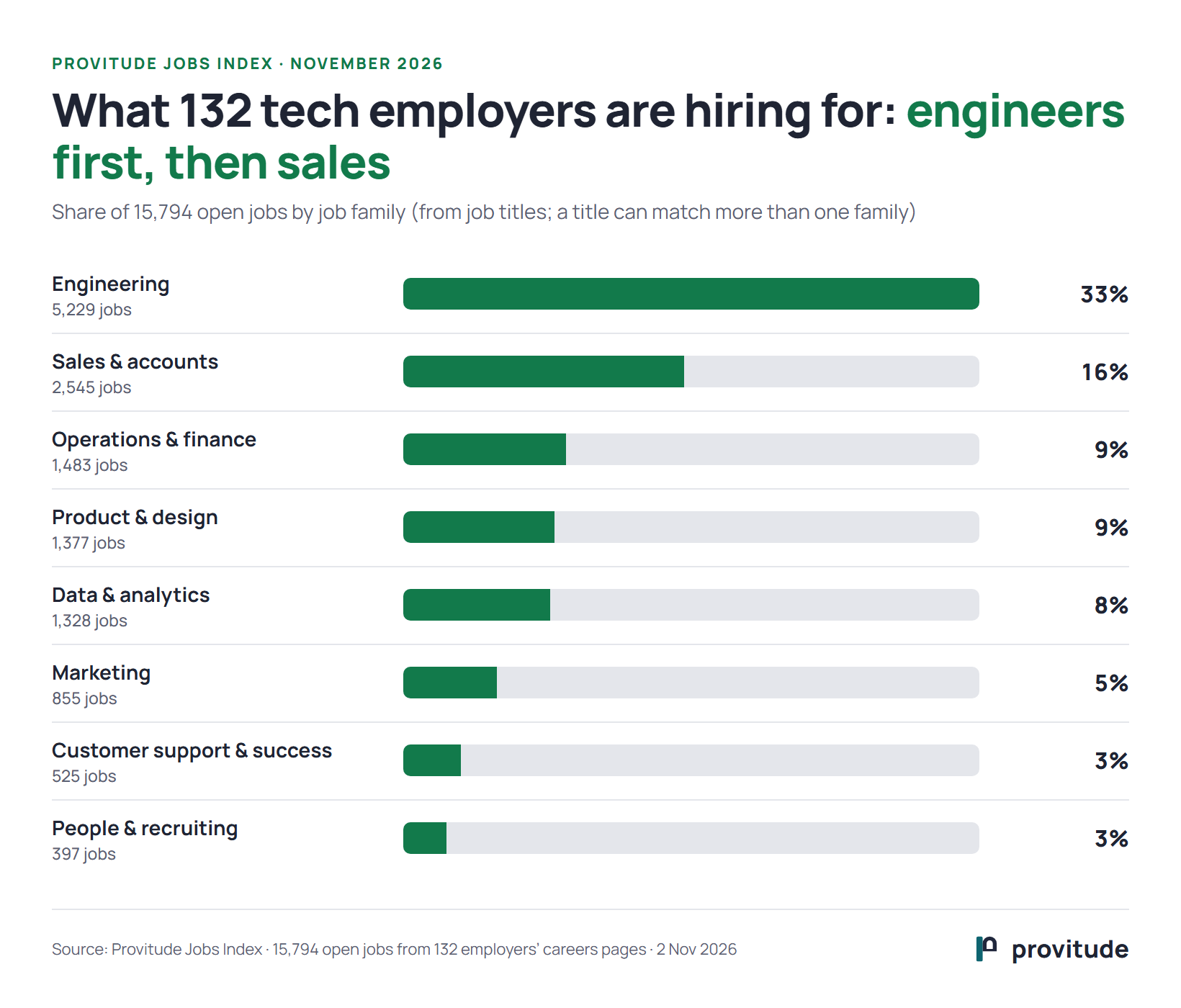
- Engineering 33%, sales and accounts 16%, operations and finance 9%, product and design 9%, data 8%
- 38.7% senior titles, 5.7% junior: about 7 senior jobs for every junior one (September: 39.3% and 5.2%)
- 357 internships open, up from 284 in September
- 6.2% of titles mention AI or machine learning (984 jobs, at 90 employers)
- Of posts that state a work arrangement: 46% remote, 36% hybrid, 17% on-site
Finding 1: a third of the jobs are in engineering
| Job family (from the title) | Open jobs | Share |
|---|---|---|
| Engineering | 5,229 | 33.1% |
| Sales and accounts | 2,545 | 16.1% |
| Operations and finance | 1,483 | 9.4% |
| Product and design | 1,377 | 8.7% |
| Data and analytics | 1,328 | 8.4% |
| Marketing | 855 | 5.4% |
| Customer support and success | 525 | 3.3% |
| People and recruiting | 397 | 2.5% |
A title can count in more than one family ("Product Data Analyst" is both product and data), and about a quarter of titles didn't match any of them (legal, security, research and many specialist roles). Even so, the shape is clear: these employers are hiring builders first and sellers second. Support, recruiting and marketing are a much smaller slice than you might guess from how many people work in them.
Finding 2: still about seven senior jobs for every junior one
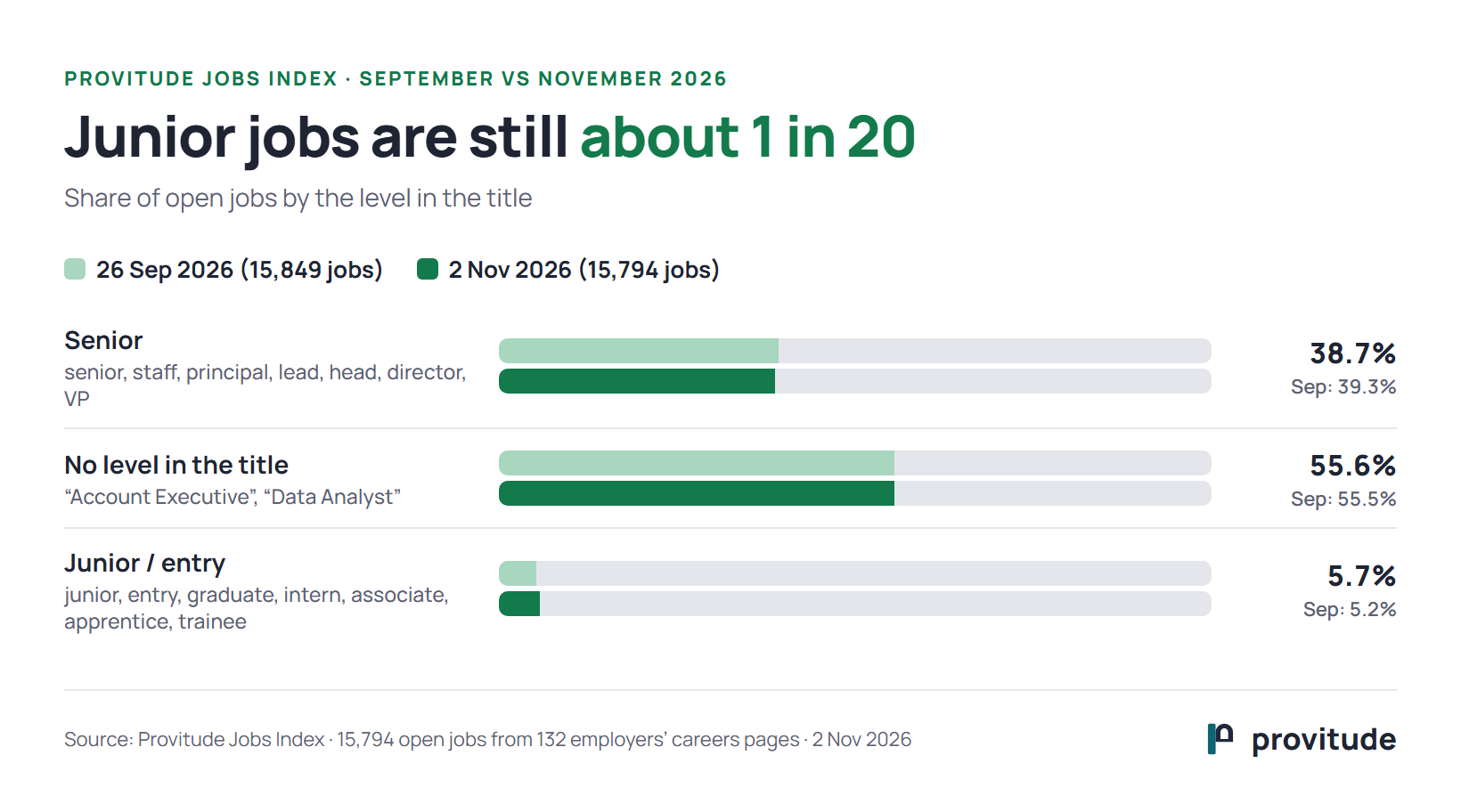
In September we found that only 5% of open tech jobs were junior. Five weeks later, with the same word lists, it's 5.7%. Senior titles slipped from 39.3% to 38.7%. That's a small move, within what you'd expect from normal churn, not a turnaround.
One number did move: internships rose from 284 to 357. 108 of them name 2027 in the title, mostly summer placements advertised months ahead. If you're a student, now is the time to apply.
The other 56% of titles have no level at all ("Account Executive", "Data Analyst"). Some of those will ask for years of experience in the description (we only analysed titles), so the share genuinely open to beginners may be smaller still.
Finding 3: AI is in 1 in 16 job titles
984 open jobs (6.2%) have AI, ML, machine learning, LLM or generative AI in the title. They're spread widely: 90 of the 132 employers have at least one. About two-thirds (666) are engineering roles, and just over half (52%) are senior.
That's a narrower picture than the headlines suggest. AI is reshaping a lot of jobs, but at these employers the jobs named after it are still a small, mostly technical, mostly senior slice. For everyone else, AI shows up in the description ("experience with AI tools a plus"), not the title.
Finding 4: almost half the jobs are in the US
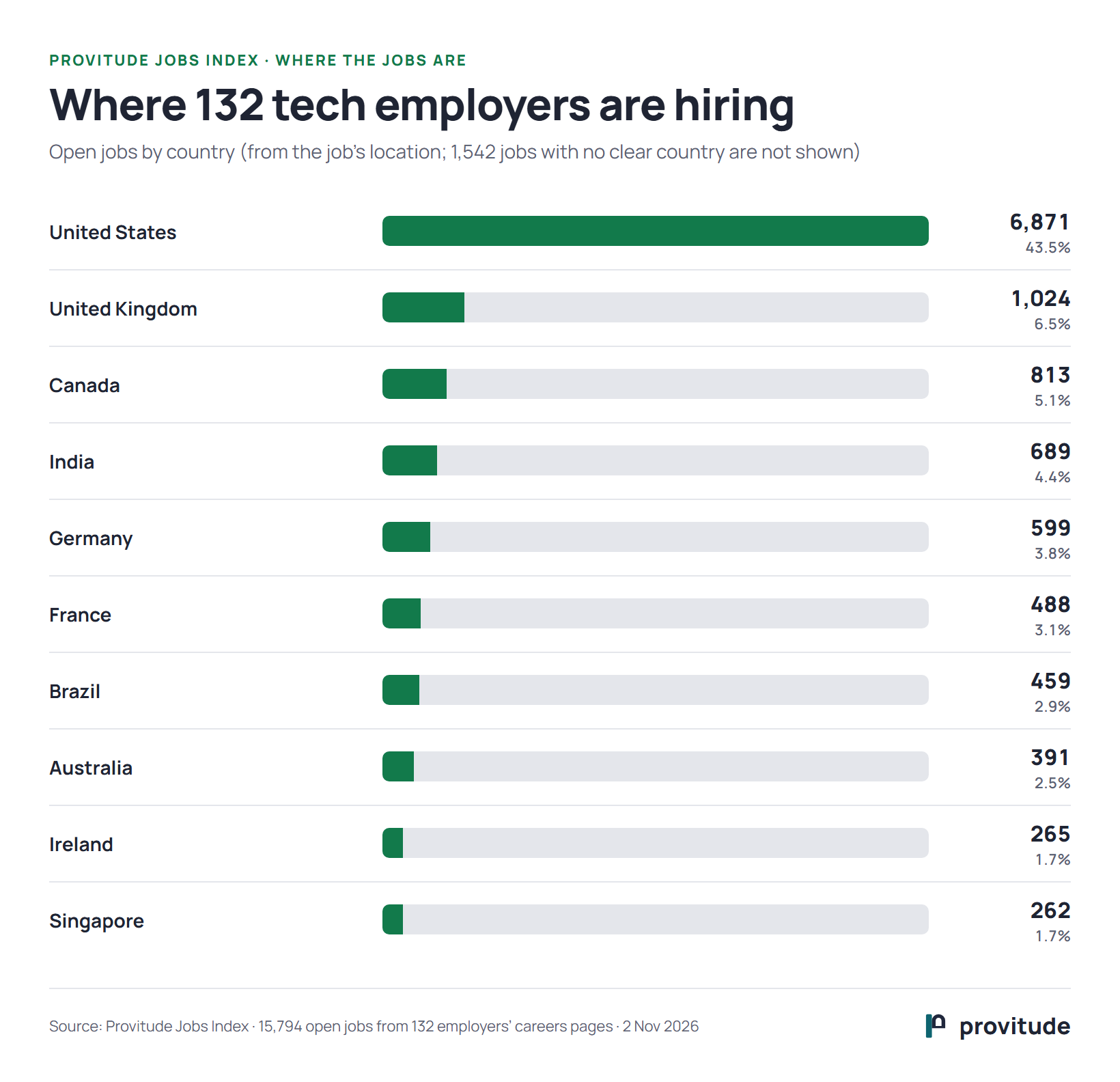
The US accounts for 43.5% of these jobs, followed by the UK (6.5%), Canada (5.1%), India (4.4%) and Germany (3.8%). About 10% had a location we couldn't tie to one country, such as "Remote" or "Europe". Remember this reflects where these particular employers hire, many of them US-headquartered, not the size of each country's job market.
Finding 5: remote is holding up, and pay is visible (in North America)
- Work arrangement: 37% of posts state one in a structured field. Of those, 46% are remote, 36% hybrid and 17% on-site, close to the 44%, 38% and 18% we found on 14 October. More on hybrid vs remote work.
- Pay: in our salary transparency report, 89% of US posts and 80% of Canadian posts stated the pay, against 14% across 11 other countries.
What the 2026 job market means if you're job hunting
- Mid-level is the sweet spot. Most jobs either have no level or are senior. If you have a few years' experience, you're applying into the biggest pool.
- If you're junior, compete on proof, not polish. With roughly seven senior jobs for every junior one, entry-level candidates need something that stands out: a work sample, a project, a skills pack. Practise for the interview you'll actually face with Provitude's practice sessions.
- Sales and engineering are where the volume is. If you're choosing between adjacent paths, there are far more openings in those two families than in support, recruiting or marketing.
- You don't need "AI" in your title, but you need it on your CV. The AI-titled jobs are mostly senior engineering. For everyone else, showing that you use AI tools well in your current work is the practical move.
- Use the pay ranges. In the US and Canada, most posts tell you the range. Use them before you answer the salary question or negotiate.
What it means if you're hiring
If you hire engineers or salespeople, you're competing with every employer in this index for the same people, so a clear, honest job ad with a pay range and a short, fair process is a real advantage. If you hire juniors, there's less competition for good ones than for experienced hires, and skills-based hiring is how small teams find them.
Methodology and limitations
- Source: the Provitude Jobs Index, open jobs on the public careers pages (Greenhouse, Lever, Ashby and SmartRecruiters) of 132 employers, mostly technology companies, collected on 2 November 2026. At most 300 jobs per employer are included, as on our jobs board; 26 large employers hit that cap, so their share is understated. Two employers whose jobs are currently hidden on Provitude were left out.
- Job families come from whole words in the job title. Engineering: engineer, engineering, developer, SWE, SRE, DevOps, architect, programmer. Data and analytics: data, analyst, analytics, scientist, machine learning, ML. Product and design: product, designer, design, UX, UI, researcher. Sales and accounts: sales, account executive/manager/director, business development, BDR, SDR, partnerships. Customer support and success: customer success, support, customer service, customer experience, CX. Marketing: marketing, growth, content, brand, communications, PR. People and recruiting: recruiter, recruiting, talent, people, HR, human resources. Operations and finance: operations, finance, financial, accountant, accounting, legal, counsel, compliance, procurement, payroll, tax. A title can match several families; these definitions are new in this report, so family shares aren't compared with September.
- Levels use the same word lists as our September report, checked in the same order (senior words first). Senior: senior, sr., staff, principal, lead, head, director, VP. Junior: junior, jr., entry, graduate, new grad, early career, intern, internship, associate, apprentice, trainee.
- AI titles: AI, ML, machine learning, LLM(s), generative, GenAI or artificial intelligence as whole words in the title. We read 15 random matches; all were genuinely AI or machine-learning roles.
- Countries come from each job's location text; jobs listing several countries, or none, aren't assigned to one.
- Work arrangement uses the structured remote, hybrid or on-site field (or the word "remote" or "hybrid" in the location), the same way our jobs board does.
- Who this represents: mostly technology employers large enough to run public careers pages. Not small businesses, retail, healthcare or government jobs, and not a measure of how many people are hired.
- The September comparison uses our 26 September 2026 snapshot (15,849 jobs from 133 employers). You're welcome to use the charts and figures with a link to this page as the source.
Frequently asked questions
What does the job market look like in 2026?
Inside the 132 tech employers we track, a third of open jobs are in engineering and one in six in sales. Hiring is weighted towards experienced people: 39% of titles are senior and under 6% junior. About 6% of titles mention AI.
Is it a good time to look for a tech job in 2026?
For experienced candidates in engineering and sales, there are a lot of openings. For beginners, junior roles are still scarce (around 1 in 18 open jobs), so a strong work sample or portfolio matters more than ever.
Which jobs are most in demand in 2026?
By number of openings at these employers: engineering roles, then sales and account roles, then operations and finance, product and design, and data and analytics.
How many tech jobs are remote in 2026?
Of the posts that state a work arrangement, 46% are remote, 36% hybrid and 17% on-site. Many posts don't state one in a structured field.
Are AI jobs taking over?
Not in job titles yet. 6.2% of open jobs at these employers have AI or machine learning in the title, mostly senior engineering roles, although many more mention AI tools in the description.